
Nine steps from the investment decision to the first harvest, an implementation timeline and honest numbers. With separate sections for raspberry and blueberry.
By Jan Sitnicki, Technical Adviser, VEGRA · Updated: 20 October 2026 · Reading time: 22 minutes
Moving from field to tunnel breaks down into three independent decisions. You can put a tunnel over your soil and change nothing else. You can stay in the tunnel and move to containers. Or you can build a full gutter system. Each stage solves a different problem and costs different money.
The reason more growers are considering it is usually the same: soil fatigue, soilborne disease and increasingly unpredictable weather. Growing under cover in soil can reduce fertility, raise salinity and alter the air–water balance, with soil pathogens on top — together this can hurt both yield and quality. Soilless production minimises the problem and also allows the harvest window to be steered.
One thing has to be said plainly: this technology requires substantial investment, and the crop is managed very differently from a field crop. Growers who commit to it must be ready to keep learning.
“I want to move into tunnels” means three different situations in practice.
Three starting points
Most first-season problems do not come from a lack of knowledge about strawberries. They come from habits carried over from soil growing that stop working in a slab.
Changing habits when moving to substrate
| In soil | In a tunnel, in substrate |
|---|---|
| Soil is a buffer — it can forgive fertilisation errors | A slab or pot holds a dozen or so litres and forgives almost nothing |
| Rain affects irrigation | Full control, and full responsibility, sit with you |
| Fertiliser applied several times across the season — unless the block has fertigation | Daily fertigation, driven by measurement |
| Roots have unlimited space | The root zone is restricted and steered |
| Soil stores water for days | A dozen or more irrigation cycles a day at peak |
| Soil analysis twice a year | EC and pH in the feed and the drain measured daily |
| Pollinators arrive on their own | Pollination has to be organised and monitored |
In return you get consistency that soil will never deliver — and that standard is what retail buyers now require.
The move does not pay off for every grower. Before you calculate the return, check whether you belong to the group that is better off staying in the field.
In Spain’s Huelva region soilless growing is not common, and the reason is purely economic: growers there prefer soil production even at lower yields, because it pays off better than investing in an expensive soilless system with full fertigation infrastructure.
A tunnel does not automatically mean soilless, and soilless does not automatically mean gutters.
Lowest entry cost
Weather protection
Soil problem remains
Medium investment
Soil isolated
Picking still at ground level
Highest investment
Picking at hand height
Full fertigation control
Three modernisation stages. Spreading them across several seasons reduces financial risk.
In a gutter system soil is replaced by a biologically clean substrate and picking happens at hand height. It is, however, the most expensive route and demands the greatest precision in installation.
For drainage to run by gravity to the end of a row — often 50–100 metres — you need a longitudinal fall of roughly 0.5–1.0%. Without it you get standing water, algae and a blocked system. Check the fall with a level before laying the slabs, not after. Also allow for the change in slab or pot weight during the season and possible gutter sag — supports spaced too far apart make this worse.
The water analysis is the first expense in the whole project, not the last. In soilless growing, poor water can complicate an entire nutrition programme, because the plant has no other source of nutrients.
When assessing water for irrigation, the laboratory should test pH, electrical conductivity (EC), bicarbonates and elements such as calcium, magnesium, iron and manganese. For fertigation water the scope is wider and additionally covers macro- and micronutrients: nitrogen, phosphorus, sulphur and chlorides, plus boron, zinc, copper, molybdenum and silicon.
There is no single universal table of limit values. Whether a given water suits your crop depends on species, system, substrate and nutrition programme — the result is interpreted by an adviser or laboratory.
The spread in capital cost depends above all on whether you are building a tunnel or a tunnel plus a full soilless system. Full ranges are in the numbers section.
Establishing a hectare of strawberries in tunnels is currently (2026) estimated at PLN 260,000–400,000, rising to as much as PLN 1 million for gutter systems. Substrate is a meaningful but not dominant line.
Also count what the price list does not show. Hand picking of strawberries costs PLN 1.50–2.50 per kilogram harvested, and in blueberry hand picking can account for up to 70% of operating costs.
Calls, limits and conditions change every year. Check the current calls with your national paying agency and advisory service before fixing the investment timeline — a call deadline can shift the whole project by a year.
Write every revenue projection with four assumptions: variety, plant density, harvest period and price. A projection without them is not a projection, it is a wish.
We have deliberately kept this step short. We make substrate; we are not a nursery or a tunnel manufacturer.
Three things from those conversations drive the substrate choice: gutter or container dimensions, plant spacing and planned crop duration.
Coco fibre has become the standard in strawberry production, but “coco” is not a single product. Below are seven criteria for comparing offers — whoever you ultimately buy from.
A number without a method means nothing. The standard is the 1:1.5 determination method; good products come in below 1.0 mS/cm and repeatedly washed material as low as 0.7. Pour-through results fall in a different range and are not directly comparable.
Raw fibre has an exchange complex saturated with potassium and sodium, and it also contains chlorides. In unbuffered coco, plants take up the sodium and potassium being released while the substrate binds calcium and magnesium from the feed. Skipping buffering can mean losses at the start of the season and, in the worst case, replacing the slabs.
Fibre holds water, chips improve drainage. Strawberry needs more fibre, raspberry more chips. The fraction is also matched to the planned crop duration — one substrate for a single season, another for two, and another again for perennial crops.
For strawberry the target air content is 15–25%. Oversized chips create voids that dry the substrate out and interrupt lateral water movement, causing channelling and uneven wetting of the slab.
Uniform material gives even root development and lets you hold the same moisture throughout the slab’s volume.
Ask whether the supplier tests every batch. Some producers state that parameters may vary between deliveries — and then your fertigation strategy may no longer fit mid-season.
Data on raw salinity, dust content and fraction ratios, plus certificates confirming freedom from disease and pests.
These seven criteria are the list of things we control when producing VEGRA MAT slabs. For container growing the equivalent is VEGRA POT, and if you fill containers yourself — VEGRA MIX.
Step 1. Row length per hectare = 10,000 m² ÷ row spacing. At 2.0 m that is 5,000 linear metres; at 2.5 m, 4,000.
Step 2. Number of slabs = row length ÷ slab length. With a 100 cm slab at 2.0 m spacing that is about 5,000 slabs per hectare.
Step 3. Plant count = slabs × plants per slab. At six plants per slab and 5,000 slabs that is roughly 30,000 plants per hectare.
Subtract headlands and service paths, usually 5–10%. Send us your gutter layout and we will calculate it precisely.
Coco’s main natural limitation is its salinity — high sodium and potassium content that must be accounted for in the nutrient solution. In Polish comparative trials strawberries in peat produced over 40% higher total yield than plants in coco, and the authors linked this to salinity. At the same time, German trials showed strawberries in peat with added coco fibre growing more strongly and yielding better than in pure peat.
Conclusion: the outcome is decided not by the raw material but by how it is prepared and matched to the nutrition programme.

Good coco substrate does not go into the gutters straight from the pack — it has to be properly expanded and stabilised.
Expansion is done with a solution containing calcium — in practice calcium nitrate at around 1–2 kg per 1,000 litres of water, because coco is naturally low in calcium and high in potassium.
High conductivity at first drain-off is natural and can be reduced: adding about 4 litres of extra solution after expansion brings the bag down to roughly 4, and 6 litres to no more than 3.
You irrigate, you see run-off, and you assume the whole slab is wet. The water may have run down channels while the core stayed dry. It also works the other way: coco can look dry on the surface while being fully moist in the root zone.
The first month can decide the whole season. This is when most of the root system is formed, and irrigation mistakes stay with you for a long time.
The most common early mistake is overwatering. Coco needs to dry back substantially between cycles — particularly in the first weeks. The root system should be lightly stressed following a dry–wet–dry rule, to push roots to grow towards lower EC — that is, higher moisture.
If the slabs dry out, coco can be rewetted thanks to its stable structure — unlike peat, which rewets only with difficulty once it has dried out.
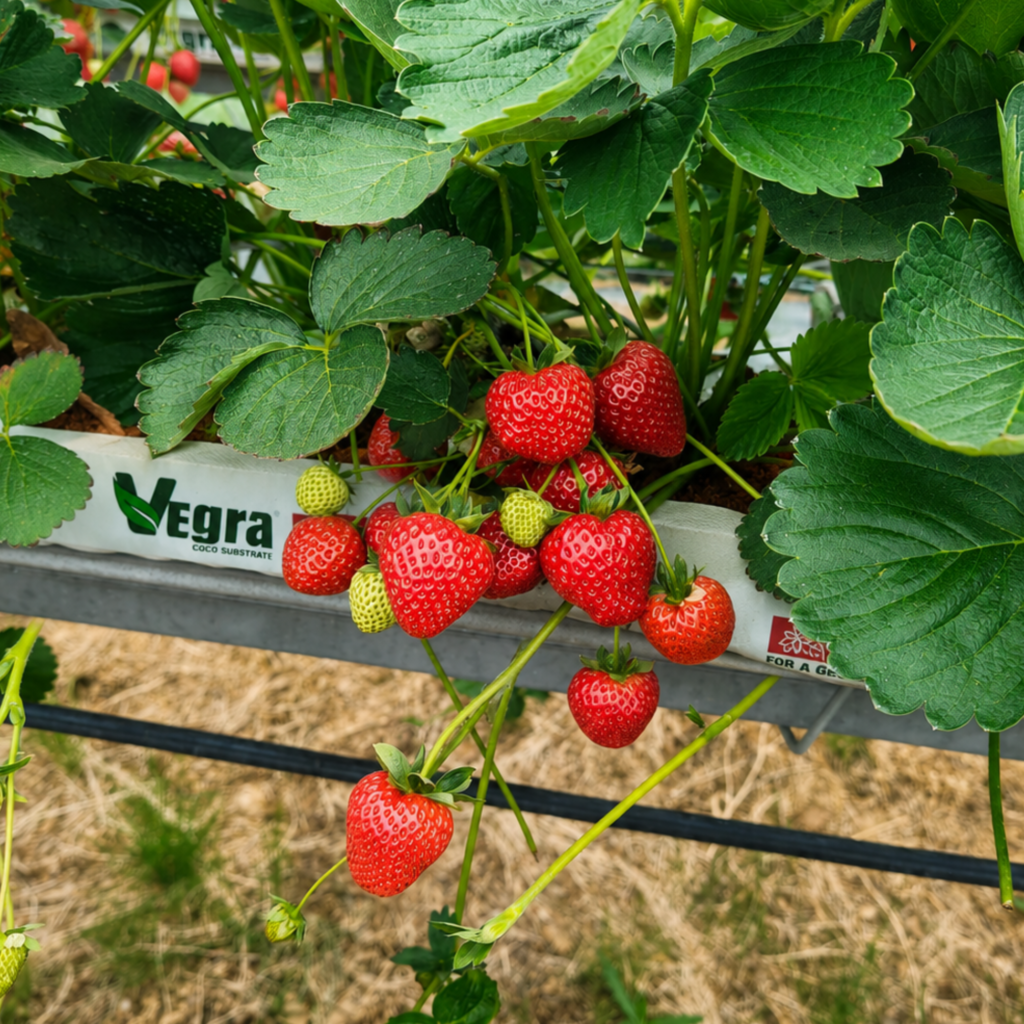
There is no universal drain percentage and no single EC value that suits every holding. What does exist is a set of measurement rules you need to impose on yourself and stick to.
The drain level is set according to light, water quality, crop stage and EC in the root zone. The goal is stable EC in the slab, matched to the condition and needs of the crop.
Minimum measurement routine in soilless growing
| Parameter | Where | How often |
|---|---|---|
| Feed EC and pH | At the mixer outlet | Daily |
| Drain EC and pH | From a vessel under the gutter | Daily |
| Drain percentage | Volume measurement | Daily |
| Slab moisture | Several points along the row | Daily |
| Dripper uniformity | Start, middle, end of row | Weekly |
| Feed and drain analysis | Laboratory | Every 2–4 weeks |
| Source water analysis | Laboratory | Before the season |
Even after washing and buffering, unwanted elements will be released to some extent during the growing season — so the nutrition programme must account for this, among other things by keeping the right ions available in the root zone. Strawberry can react badly to excess chloride, so chloride-based fertilisers are avoided and replaced with sulphates or nitrates.
In a tunnel you cannot assume pollinators will arrive on their own (although they sometimes visit tunnels readily). In a season when weather conditions did not favour pollinator activity, this translated directly into poorer fruit set and deformed fruit. Deformed fruit is fruit outside the dessert grade.
To settle before flowering: bumblebee hive supplier, placement date and number of hives, tunnel ventilation on hot days, a spray programme coordinated with pollinator activity, and hives positioned in shade.
More and more growers run slabs for more than one season. The saving is real but moderate — around 8–10%. The condition is that slabs have not settled excessively. If the substrate has settled by more than 20%, continued use becomes risky. Also watch for pests overwintering in the slabs — they can cause problems at the start of the next crop cycle.
Reuse comes with compaction and a risk of carrying over disease. Spent slabs can, however, be used for other crops or as organic soil amendment.
Laid out for everbearing strawberries with a spring start. It covers a year of preparation plus the first growing season; shift the dates if you plan a different cycle — the order stays the same.
Indicative timeline for moving to substrate production
| Period | What you do | What you cannot miss |
|---|---|---|
| Stage I — preparing the investment (approx. 12 months) | ||
| Sep – Nov | Investment decision, water analysis, system choice, provisional plant booking | Water analysis before anything else |
| Nov – Jan | System design, costing, funding application | Application deadlines |
| Feb – Apr | Structure build, gutter and fertigation installation | Gutter fall checked with a level |
| May – Jun | System testing, dripper uniformity checks | Test at full load |
| Jul – Aug | Order the substrate | End of August at the latest |
| Stage II — starting the crop (following season) | ||
| Feb – Mar | Delivery, laying out, initial wetting, measurements | Expand, preferably with a calcium solution |
| Spring | Planting, depending on the production cycle | First 30 days under close control |
| Before flowering | Bumblebee hives placed, spray programme coordinated | Order pollinators well in advance |
| Harvest period | Fertigation, drain control, picking | Stability matters more than the absolute value |
| After the season | Assess slab condition, decide on a second season | Cut open a few slabs and measure settling |
Send us your gutter or container dimensions, planned plant density and crop — we will prepare a substrate specification and the quantities you need. No obligation.
Raspberry in containers is a different production system, not the same technology with another plant.
Blueberry is the only one of the three crops in which coco is not used on its own. The reason is pH.
Under cover, target pH is cited at 3.8–4.4, although most sources give a wider 4.0–5.5 range. Coco sits around 6.5. In container production a mix of roughly 40% coco fibre, 40% high-moor peat and 20% perlite is used, in containers of around 30–50 litres.
The second difference is time: income comes only 3–4 years after planting, and bushes reach full cropping after 6–7 years. A container does not shorten the plant’s biological cycle.
Water parameters drive both structure choice and the nutrition programme.
How to avoid it: put the water analysis first in the budget.
Orders are best placed in July, by the end of August at the latest.
How to avoid it: diarise the date as soon as the variety is chosen.
Without the measurement method, two values can describe entirely different realities.
How to avoid it: ask for the method and compare like with like.
A slab holds no nutrient reserve and no buffer.
How to avoid it: have the nutrition programme and working measurement in place before planting.
Permanent saturation during root formation leaves a weak root system for the rest of the season.
How to avoid it: let the slab dry back between cycles.
No fall means standing water, algae and a blocked system.
How to avoid it: check the fall with a level before laying slabs.
Poor pollination means poorer fruit set and deformed fruit.
How to avoid it: book bumblebee hives well in advance.
A few per cent saved at the cost of a whole crop.
How to avoid it: cut open several slabs after the season and assess the structure.
Water and feed can be corrected daily — substrate cannot be changed once the crop is planted.
How to avoid it: express substrate cost as a percentage of the whole investment first.
The figures below come from publicly available industry estimates and advisory calculations. They are not VEGRA data and not results from any single holding.
The three-crop comparison is not symmetrical. Strawberry is a one- or two-year crop with a fast return, raspberry has the widest spread between sources, and blueberry is a perennial in which coco is a mix component.
| Parameter | Field | Tunnel, in substrate |
|---|---|---|
| Establishment cost per ha | approx. PLN 55,000 (raised beds with fertigation) | PLN 260,000–400,000, up to PLN 1 million for gutter systems |
| Yield | 14–18 t/ha | 15–60 t/ha of dessert-grade fruit |
| Annual costs incl. picking | PLN 40,000–65,000/ha | Higher: fertigation, substrate, energy |
| Price | Dessert PLN 6–7/kg, processing PLN 2–4/kg | Premium for timing and grade |
| Time to full yield | Second year | First season |
| Parameter | Field | Tunnel |
|---|---|---|
| Establishment cost per ha | PLN 73,000–86,000 (summer), approx. PLN 43,000 (autumn) | from approx. PLN 337,000 up to PLN 700,000–1,000,000 |
| Yield | 6–12 t/ha | Year 1: 4–8 t/ha; from year 2: 10–18 t/ha |
| Annual costs | PLN 50,000–80,000/ha | PLN 85,000–90,000/ha up to over PLN 400,000/ha |
| Time to full yield | Year 2–3 | Long cane — crops in the planting year; plug — small crop in the planting year, full crop in year 2 |
Conclusion: for raspberry the spread between sources runs to an order of magnitude. Do not plan an investment on someone else’s ranges.
| Parameter | Field | Under cover, in containers |
|---|---|---|
| Establishment cost per ha | PLN 65,000–180,000 | Higher with tunnel covering |
| Yield | 8–15 t/ha on a mature plantation | Higher and more consistent |
| Annual maintenance | PLN 35,000–55,000/ha | Higher by fertigation and container handling |
| Price | PLN 10–15/kg, premium around PLN 21/kg | Premium for out-of-peak timing |
| Time to full yield | 3–4 years, maximum after 6–7 years | Containers do not shorten the plant cycle |
| Role of coco | — | Mix component: approx. 40% fibre, 40% peat, 20% perlite |
No. Many holdings do it in stages: first a tunnel over soil, then containers, and gutters last. Spreading it out reduces financial risk.
It follows from row spacing, not from area. At 2.0 m spacing with a 100 cm slab it works out at about 5,000 slabs per hectare. The full calculation is in the substrate section.
Washing removes excess sodium, chloride and potassium. Buffering then saturates the exchange complex with calcium, so the substrate does not sorb calcium from the feed.
The saving reaches 8–10%, but only if settling is limited. Beyond 20% settling, continued use is risky. It is also worth checking that no pests are overwintering in the slabs.
Not as a stand-alone substrate — blueberry needs pH around 3.8–4.4. Coco is used as a component of a mix.
Ideally in July, by the end of August at the latest ahead of the season.
Spent slabs can be used for other crops or as organic soil amendment.
Information current as of October 2026. Market figures are industry and advisory estimates, not official statistics.
This material is informational. Cost and yield ranges are industry estimates and do not constitute a forecast for any individual holding.
Ensure consistent quality, pH/EC stability, and complete control over your crop. A premium harvest your customers will appreciate.
Vegra – Modern technologies of coconut substrates.
© 2026 Vegra.eu | All rights reserved. Created by idztech.pl